

Meta's 2026 Performance Marketing Summit: 5 Things Every Creative Strategist Needs to Know
Creative Strategy
Meta's 2026 Performance Marketing Summit covered creators, AI, and ad performance in depth. Here are the 5 most important takeaways for creative strategists, and what they mean for your briefs.
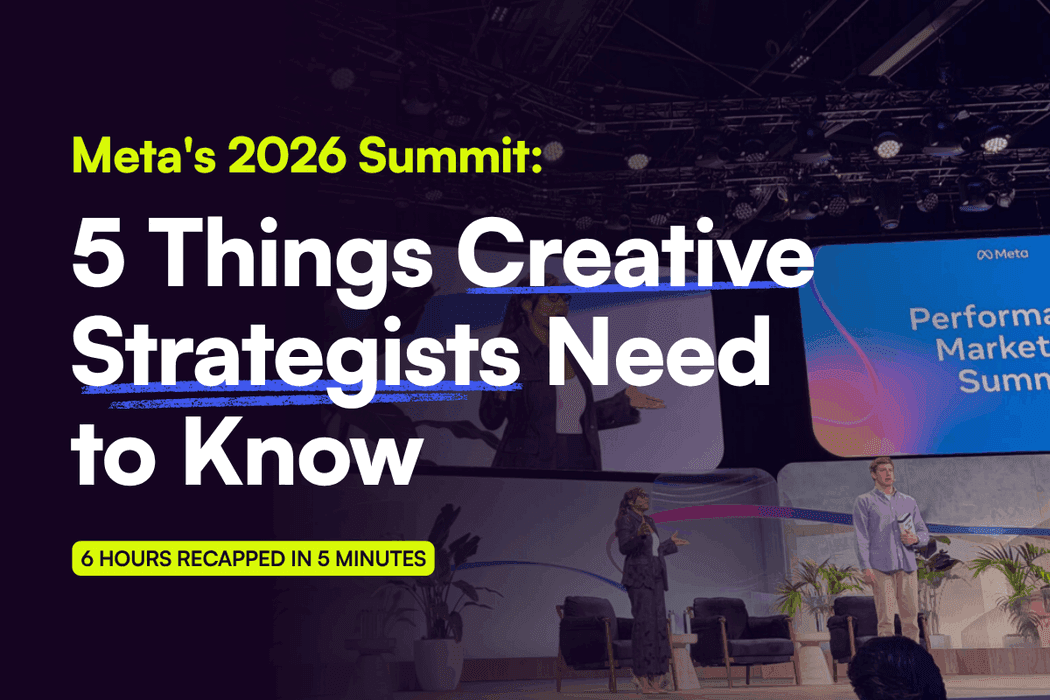
Meta's 2026 Performance Marketing Summit ran for six hours. We sat through all of it so you don't have to.
The big picture: AI didn't make creative cheaper, it raised the floor. The advantage now belongs to strategists who produce sharper concepts, brief creators properly, and bring real thinking to a job that's being automated around the edges.
Below are the five most important takeaways for anyone working in creative strategy, and what each one means for the way you work.
What Changed Between 2025 and 2026
A year ago, the dominant conversation in performance marketing was about tools, which AI platforms to adopt, how to automate production, how to generate more content faster. The 2025 summit was largely optimistic about volume as a competitive advantage.
2026 told a different story. The brands that went all-in on volume without sharpening their strategy saw diminishing returns. The signal-to-noise ratio in paid social dropped. Audiences got better at ignoring content that felt manufactured, and Meta's algorithm got better at identifying it.
What emerged from this year's summit was a recalibration: away from production volume as a moat, toward strategic thinking as the differentiator. The tools are table stakes now. The question is who's using them to execute better ideas, not just more of them.
That shift runs through every session below.
1. Creators Are Infrastructure Now, Not a Campaign Tactic
The framing that dominated the first half of the summit was blunt: stop treating creator work as a launch lever. It's the layer everything else sits on.
For years, the standard model was to build a campaign, lock the creative, then identify creators to amplify it. That model is broken. The brands scaling fastest on Meta have inverted it, they bring creators into the brief before the concept is set, not after.
The data backs this up. Partnership Ads, ads that run from creator accounts rather than brand pages, now outperform standard ads by a significant margin across every metric that matters:
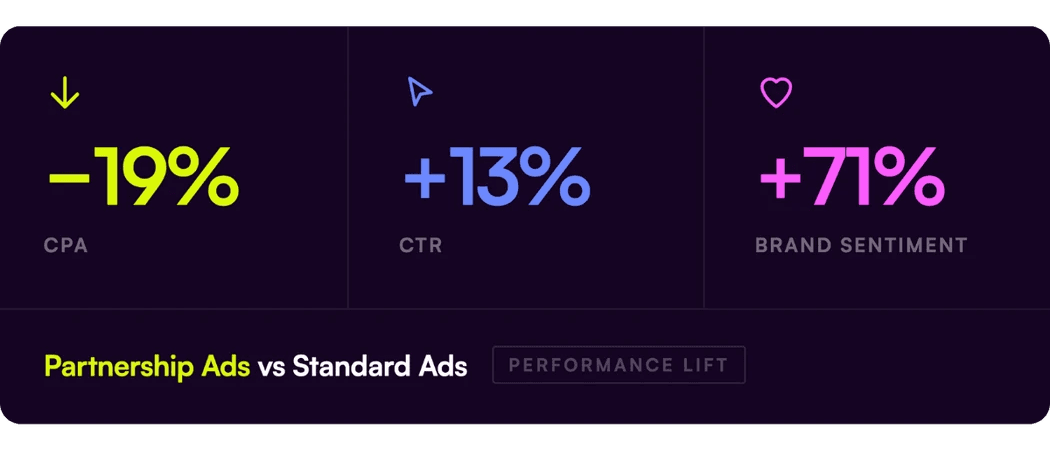
81% of people who follow creators say they value expertise over notoriety. Follower count ranked dead last as a reason to trust a creator. What audiences respond to is real knowledge and genuine affinity with a product, not reach.
Hungryroot committed $8.5M to Partnership Ads and saw 60% year-over-year growth in brand awareness. That's not a test budget. It's a structural decision about where the brand lives in the feed.
The underlying reason this works comes down to how Meta's algorithm is trained. It's built on what real users engage with, and that's overwhelmingly other real people. Creator content gives the system richer signal than polished brand assets. The algorithm rewards it accordingly.
What this means for your work: Creator integration isn't a nice-to-have in the brief. It belongs in your media strategy from the start. If you're casting creators after the concept is locked, you're already behind, and you're leaving the strongest performance lever on the table.
2. Over-Briefing Kills the Thing You're Paying For
This was the most repeated point across every creator panel at the summit: give the message, not the script.
The instinct to over-brief is understandable. Brands want consistency. They want brand safety. They want to make sure the creator says the right thing. But the more you try to control what a creator says, the more you remove the one element that made you want to work with them in the first place: their voice.
When a creator reads a script, the audience knows. The performance drops. The engagement drops. And the algorithm notices.
The brief structure that emerged from Meta's top-performing creator partners is deliberately minimal:
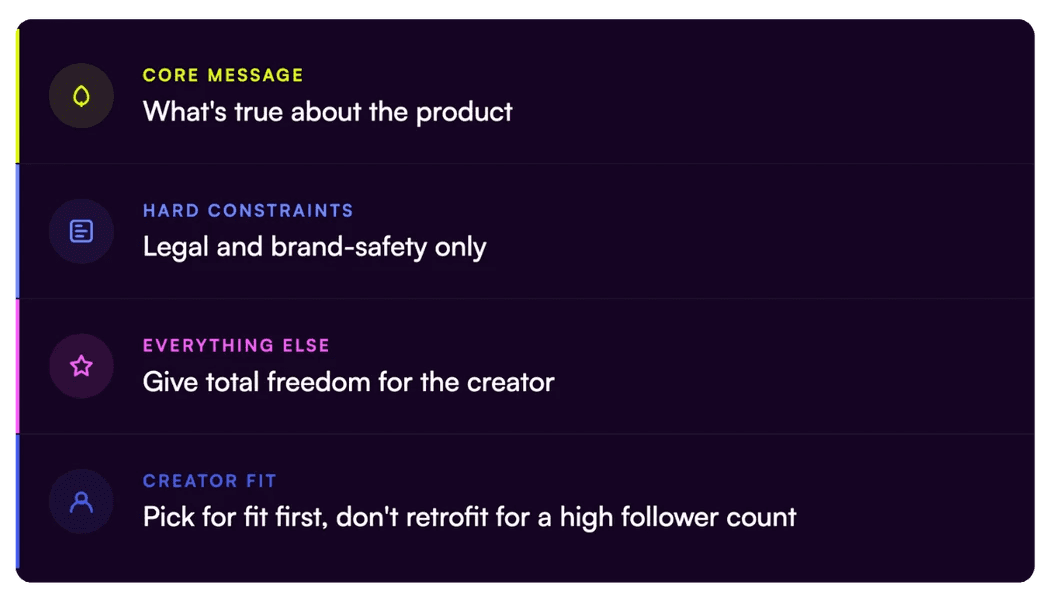
The principle is simple: when you brief a creator on what to say, you get a performance. When you brief them on what's true, you get content that feels real, because it is.
This also reframes how you think about creator selection. If you need to write a detailed script to make the content work, you've chosen the wrong creator. The right creator should be able to take the core message and run with it, because they already believe it.
What this means for your work: Pull up your last creator brief. Does it tell the creator what to say, or what's true about the product? If it's the former, that's the rewrite. One change to the brief structure can change the entire output.
3. Concept Differentiation Beats Variant Explosion
AI has removed the production bottleneck. Ridge made 700 unique ads in 10 business days. Mango generated over 10,000 catalog videos in 30 minutes of work. The capability is real, and it's accessible to most teams now.
The problem is that most brands are using it to solve the wrong problem. More variants of a weak concept is still a weak concept, multiplied.
Eric Seufert put it plainly: 50 versions of the same idea is mostly noise. The real leverage is deciding what to make before you make anything. Use AI to rank and stress-test concepts before you spin up the production machine. Then make a handful of them well.
Preston Rutherford (Chubbies) offered a test that cuts through the noise: would you proudly show this ad to your friends, or would they say 'you're trying to sell me something'? If it's the latter, no amount of variation or optimisation fixes it. The problem is upstream, in the concept, not the execution.
This is where creative strategy earns its value. Production is increasingly commoditised. The decisions made before production, what angle, what format, what insight, what story, are where the gap between average and exceptional creative gets made.
What this means for your work: Volume isn't a strategy, it's a production output. Before you brief a new concept, ask whether you're solving an execution problem or a thinking problem. Most of the time, it's the latter.
4. Brand Creative Drives Performance: The 95/5 Rule
At any given moment, only about 5% of your potential customers are actively in-market. They're comparing options, reading reviews, close to a decision. The other 95% aren't ready to buy today, but they will be eventually, and the brand they remember when they are will win.
Most performance briefs are written entirely for the 5%. Direct response hooks, urgency framing, promotional offers. That's not wrong, but it's incomplete.
The 95/5 rule says every brief should answer two questions: what does this ad do for the 5% ready to buy now, and what does it plant in the mind of the 95% who'll be ready later? Brand and performance aren't separate jobs anymore. The brief is where you decide whether you're building for the moment or building for the market.
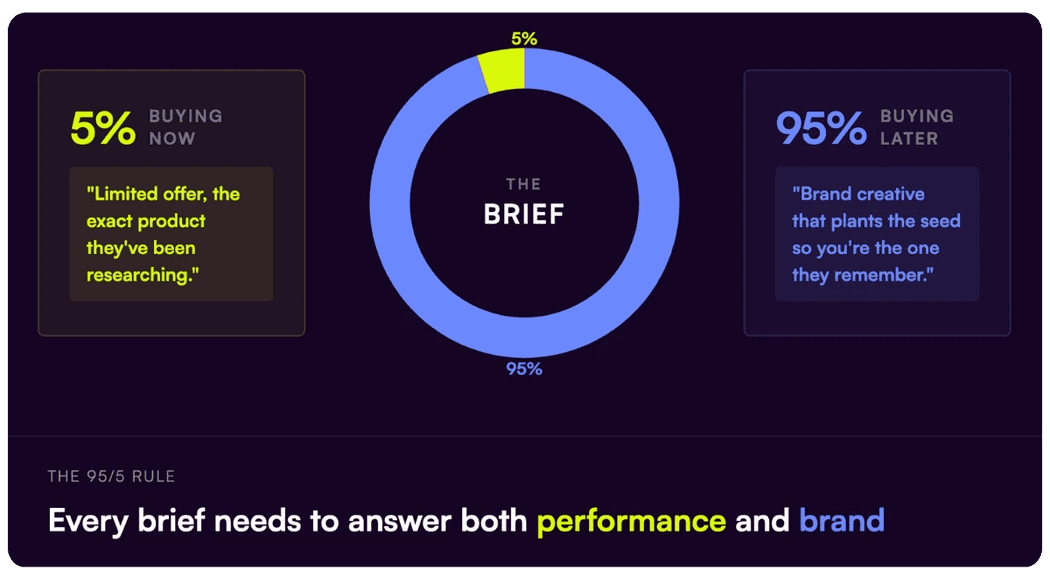
The brands that won on Meta over the past 18 months weren't running more performance ads, they were running smarter briefs that did both jobs at once. Creative that earns attention, builds a point of view, and still converts when the moment comes.
What this means for your work: If your briefs only optimize for the 5% ready to buy today, you're leaving significant ROI on the table and training your audience to expect promotions. Start asking what each brief does for the 95% who aren't ready yet.
5. Build the Muscle for Real Thinking, It's About to Be Rare
Harper Carroll closed the summit. She's an AI educator and former Meta executive, and she made what we think was the most important argument of the day for anyone working in creative.
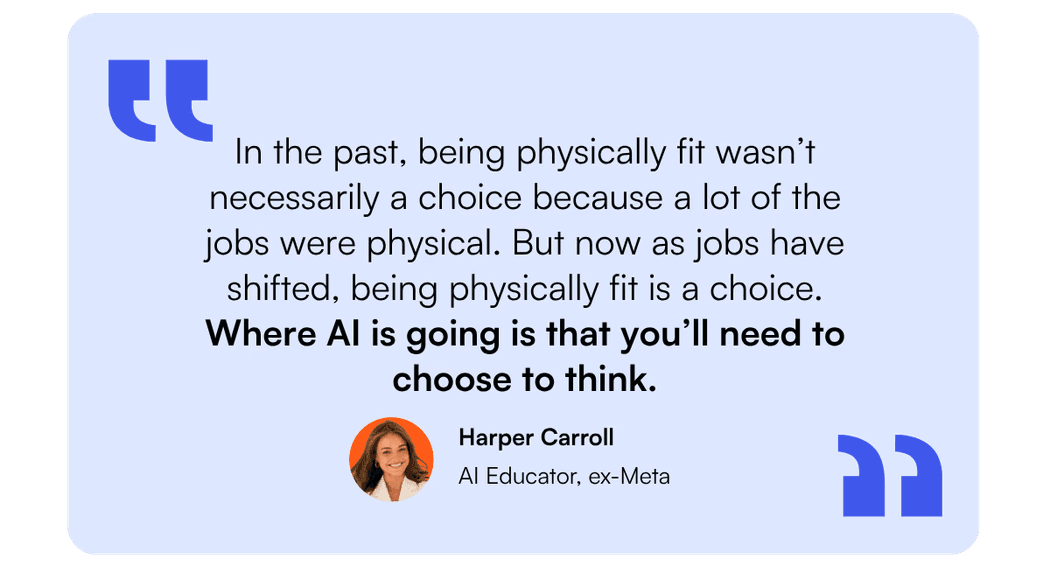
The analogy is precise. We don't need a gym to survive anymore, but we go to one because we know what happens without it. Physical fitness used to be built into the job. Now it's something you have to pursue deliberately.
Carroll's argument is that thinking is about to follow the same trajectory. The default will increasingly be to let the machine produce the asset, run the analysis, generate the concept. Most people will take that default. The cognitive load of producing creative output will drop, and so will the average quality of thinking behind it.
The people who deliberately build the muscle for real creative thinking, who choose the harder path of pressure-testing an insight, stress-testing a brief, working through a problem rather than prompting past it, will become rare. And rare, in any market, is valuable.
Her phrase from the session: optimize for mental struggle. Not comfort, not efficiency, not speed. Struggle, because that's where the thinking that can't be automated actually happens.
What this means for your work: The strategists who'll matter most over the next decade aren't the ones with the most AI tools. They're the ones who can still think from first principles, pressure-test an insight, and write a brief worth a creator's time. AI handles the production. You bring the thinking it can't.
How Ad Creative Academy Teaches Every One of These Skills
Every insight from this summit points to the same conclusion: the advantage in creative belongs to strategists who can think, not just those who can produce. That's what Ad Creative Academy was built to develop.
On creator briefing and over-briefing
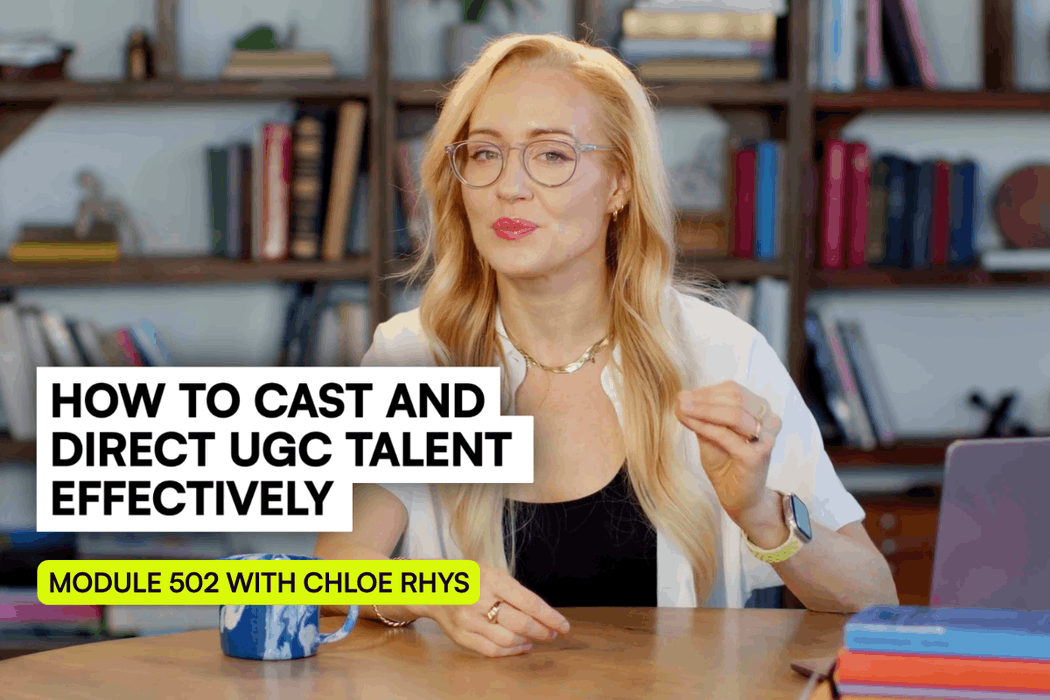
Chloe Rhys (Ex-Executive Creative Director, TubeScience) teaches casting and directing UGC talent inside the Academy. Her module covers why 80% of great UGC starts in the brief, not on camera, and how to brief creators on what's true about a product rather than what to say. Directly applicable to Takeaways 1 and 2 above.
On concept selection and creative research
Zach Murray, founder of Foreplay, teaches the research system behind the world's best-performing creative. His module covers how to study what's actually winning in your market, how to identify patterns worth building on, and how to use AI to multiply those inputs into better concepts, not just more variants.
On brand-performance balance and the 95/5 rule
Ashley Vinson (Ex-Creative Agency Partner, Meta) and Carlotta Costanzo (Creative Performance Director, GAIN) both address the relationship between brand-building and performance in their respective modules, covering how to structure briefs that serve both jobs, and how to test creative without losing the signal that makes it work.
On building the thinking muscle
This is the throughline of the entire Academy curriculum. Every module is built on the premise that AI handles execution, but strategic thinking is the skill that compounds. The Academy teaches frameworks, not shortcuts: the Building Blocks Framework, the Five Stages of Market Awareness, and the PMBO brief-writing system, among others.
The Real Takeaway
Every session at Meta's 2026 Performance Marketing Summit pointed to the same conclusion: the advantage has shifted to strategists who think, not just those who produce.
Creator integration, brief quality, concept selection, brand-performance balance, creative thinking, these are all strategy problems. They can't be automated. And they compound over time in a way that production volume never will.